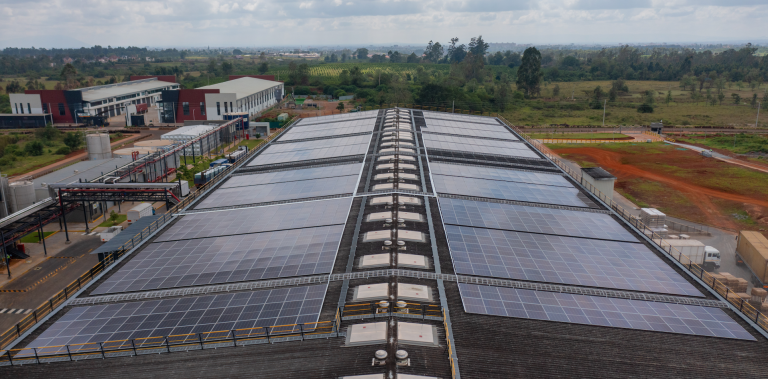
Kenya Wine Agencies Limited’s commissioning of a 700kV rooftop solar plant at its Tatu City factory is being celebrated as a sustainability milestone. Yet beneath the public messaging lies a more complex story about cost pressures, power reliability, and shifting industrial strategy. Manufacturers are increasingly being forced to rethink energy not as a utility, but as a balance-sheet risk.
Energy remains one of the most volatile inputs in Kenya’s manufacturing sector. Grid instability, rising tariffs, and currency exposure have pushed firms to search for alternatives that protect margins while maintaining output.
Why KWAL moved now
KWAL’s decision to invest through a Power Purchase Agreement signals caution as much as ambition. By avoiding upfront capital expenditure, the company limits financial risk while locking in predictable energy pricing. This approach reflects a broader trend where manufacturers hedge against energy uncertainty rather than betting on grid reform alone.
Managing Director Lina Githuka framed the move as part of long-term efficiency goals. Industry analysts, however, point to immediate cost containment as an equally powerful driver.

The numbers behind the narrative
The solar system will supply at least 15 percent of KWAL’s annual electricity needs, translating to estimated energy cost savings of 7.5 percent. In an industry where margins are often squeezed by logistics, taxation, and import costs, such savings are significant. Even modest reductions can reshape pricing power and competitiveness.
These savings also insulate the business from future tariff shocks. As energy prices fluctuate, predictability becomes a strategic asset rather than an operational convenience.
PPA model under scrutiny
The choice of a PPA model deserves closer examination. Under this structure, the developer owns and operates the plant while KWAL purchases power at an agreed rate. This shifts maintenance, performance, and technology risks away from the manufacturer.
For firms wary of technological obsolescence or regulatory shifts, PPAs offer flexibility. However, critics argue they can lock companies into long-term contracts that limit future renegotiation as technology prices fall.
Grid reliance is not gone
Despite the solar installation, KWAL remains connected to the national grid. The system supplies power during daylight hours and transitions seamlessly to grid electricity at night. This hybrid model reflects a pragmatic understanding that renewables alone cannot yet guarantee uninterrupted industrial output.
It also highlights a quiet truth in Kenya’s energy transition. Renewable adoption is not about replacement, but optimization, where firms blend sources to balance cost and reliability.
Tatu City as a testbed
KWAL’s Tatu City facility was designed with energy efficiency in mind, earning EDGE certification from inception. This positioning makes it an ideal site for renewable experimentation. Not all factories enjoy such structural advantages, raising questions about scalability across older industrial zones.
EDGE certification is more than a badge. It unlocks access to green financing, lower interest rates, and international capital that increasingly favors low-carbon operations.

Green financing motivations
Director of Supply Chain Mwenda Kageenu openly linked certification to financing access. This reveals how sustainability is becoming a prerequisite for capital rather than a branding exercise. Banks and development finance institutions are tightening criteria, rewarding efficiency and penalizing carbon-heavy operations.
For manufacturers seeking expansion or modernization capital, sustainability credentials now carry tangible monetary value. KWAL’s phased plan to scale solar capacity to 1,500kV reflects anticipation of this financing landscape.
Regulatory hurdles quietly crossed
The project received approvals from EPRA, Tatu Power, and the Tatu Development Control Company. While mentioned briefly, these approvals represent a significant regulatory milestone. Energy projects in Kenya often stall at licensing and grid interconnection stages.
By clearing these hurdles within eight months, KWAL and its partners demonstrate how coordinated planning can accelerate renewable deployment. This efficiency, however, is not uniformly available to smaller manufacturers lacking institutional leverage.
The IFC’s strategic role
The involvement of the International Finance Corporation signals global interest in Kenya’s industrial decarbonization. IFC participation often comes with rigorous environmental and governance requirements. Its presence lends credibility while subtly shaping project design and reporting standards.
This raises a broader question. Are Kenyan manufacturers transitioning voluntarily, or responding to external financing pressure that increasingly dictates operational choices?
Manufacturing and Kenya’s 2030 target
Kenya aims to achieve 100 percent renewable energy by 2030. While the grid is already heavily renewable, industrial consumption remains a challenge due to scale and reliability demands. Rooftop solar plants like KWAL’s help bridge this gap incrementally.
However, the cumulative impact depends on replication. One factory’s success does not guarantee sector-wide transformation without supportive policy and financing frameworks.

Carbon neutrality and competitiveness
EDGE Zero Carbon certification represents the highest standard in green building operations. Achieving it requires deep energy savings and full renewable offsetting. KWAL’s trajectory suggests a strategic bet that carbon-neutral operations will soon be commercially advantageous.
Export markets, particularly in Europe, are tightening carbon disclosure requirements. Manufacturers unable to demonstrate low-emission operations may face non-tariff barriers disguised as sustainability standards.
Is this a competitive necessity?
As peers adopt similar measures, renewable energy may cease to be a differentiator and become a baseline requirement. Early movers like KWAL enjoy first-mover advantages in financing and brand positioning. Late adopters risk being locked out of favorable capital and partnerships.
The question is not whether green manufacturing is viable, but how long firms can afford to delay adoption.
What remains unsaid
Public announcements often emphasize sustainability, but rarely discuss payback timelines or contractual constraints. The long-term implications of PPAs, tariff escalation clauses, and performance guarantees remain opaque. Transparency will determine whether such models truly benefit manufacturers over decades.
For now, KWAL’s solar plant stands as both a symbol of progress and a case study in industrial adaptation under economic pressure.
The bigger picture
KWAL’s move reflects a broader recalibration within Kenya’s manufacturing sector. Energy is no longer just an operational input; it is a strategic variable shaping investment, competitiveness, and survival.
As more factories follow this path, the real transformation will not be measured in megawatts installed, but in how decisively Kenyan industry repositions itself for a low-carbon global economy.