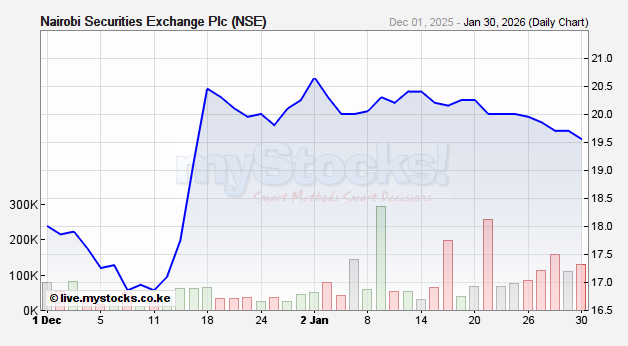
Kenya Airways Plc’s stock has become one of the most talked-about equities on the Nairobi Securities Exchange in recent days. Between January 15 and late January 2026, the carrier’s share price climbed about 69.7 percent, turning it into the top gainer over eight straight trading days as investors hunted for gains tied to rumours of a strategic investor. The stock closed at Sh5.50 on Tuesday after hitting Sh3.24, generating roughly Sh13.1 billion in paper value for holders in that brief span. Despite its dramatic rise, the official narrative on the potential investment remains opaque, leaving market watchers to read between the lines.
Thank you for reading this post, don't forget to subscribe!
What ignited the rally
The surge follows widespread reports circulating in the market of ongoing talks between Kenya Airways and potential external investors, including a Middle Eastern airline and a Singapore-based firm. Those reports stoked optimism among investors, though the Singapore entity later denied involvement. Kenya Airways itself declined to confirm specifics, with its director of communications, Henry Okatch, saying only that discussions with “various stakeholders and potential investors” were underway and that material developments could only be disclosed once concluded in line with Capital Markets Authority regulations.
Behind the euphoric trading lies an airline that has struggled for years with structural losses and financial instability. For much of the past decade, Kenya Airways has faced mounting operational challenges, including grounding of aircraft due to global supply-chain constraints and sporadic profitability. In the half-year to June 2025, the company reported a negative book value — meaning liabilities outweighed assets — of Sh129.5 billion, underscoring deep-rooted balance sheet stress.
Boardroom manoeuvres and creditor stakes
Amid the stock surge, a key corporate governance development added another layer to the unfolding story. Esther Koimett, a veteran banker and public servant, was appointed to the Kenya Airways board to represent lenders tied to the airline’s debt restructuring. Koimett’s track record includes high-level government roles and previous board service for the airline during her tenure at the National Treasury. Her return is largely seen by industry insiders as a move to give creditor interests a stronger voice in steering the airline’s strategic direction.
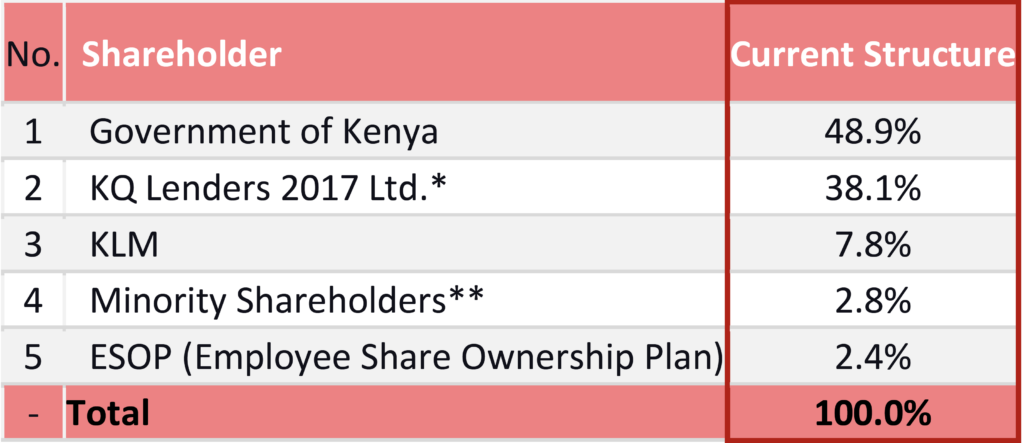
The lenders’ bloc, formalized through KQ Lenders Company 2017 Limited, holds about 38 percent of Kenya Airways alongside government shareholding of 48.9 percent. The consortium includes major Kenyan banks such as Equity Bank, KCB, Co-operative Bank, National Bank of Kenya, and others, making it a formidable shareholder group with significant influence on corporate affairs. The inclusion of a representative on the board is widely interpreted as more than symbolic — it signals lender seriousness about protecting and potentially enhancing their investment amid restructuring negotiations.
Rumours vs reality in a volatile market
Despite the stock’s spike, sceptics caution that the rally may be more speculative than substantive. Market participants are quick to note that no binding agreement with a strategic investor has been publicly confirmed, and the denial of interest by one reported prospective buyer casts further doubt on the clarity of the situation. Analysts familiar with airline capital-raising cycles stress that until a definitive partnership, capital injection, or board-sanctioned recapitalization plan is released, trading exuberance may be premature.
The airline’s broader financial context is sobering. Independent reports and financial disclosures reveal that Kenya Airways has struggled with profitability and capacity issues, including a Ksh12 billion loss reported in the first half of 2025 and supply-chain-induced grounding of key aircraft that constrained revenue generation. These ongoing operational strains have made clear the urgency of securing new capital and strategic partnerships if the carrier is to break from a cycle of instability.
Beyond the buzz
For retail investors drawn to the recent price momentum, the KQ story underscores the risks and rewards of trading on speculative news. Regulatory frameworks in Kenya require listed companies to disclose material information only when it is definitive, leaving markets to react to unconfirmed developments at their own risk. The Kenya Airways episode thus highlights the tension between investor sentiment and corporate transparency standards.
As Kenya Airways continues to navigate its complex restructuring and investor outreach efforts, the market’s next moves will hinge on clarity — not rumour. Whether the airline can secure meaningful external investment that legitimizes the stock rally remains to be seen, but for now, traders and analysts alike are closely watching every disclosure for signs of a true turning point.